
Is macOS a Better Runtime Environment for Local AI Agents?
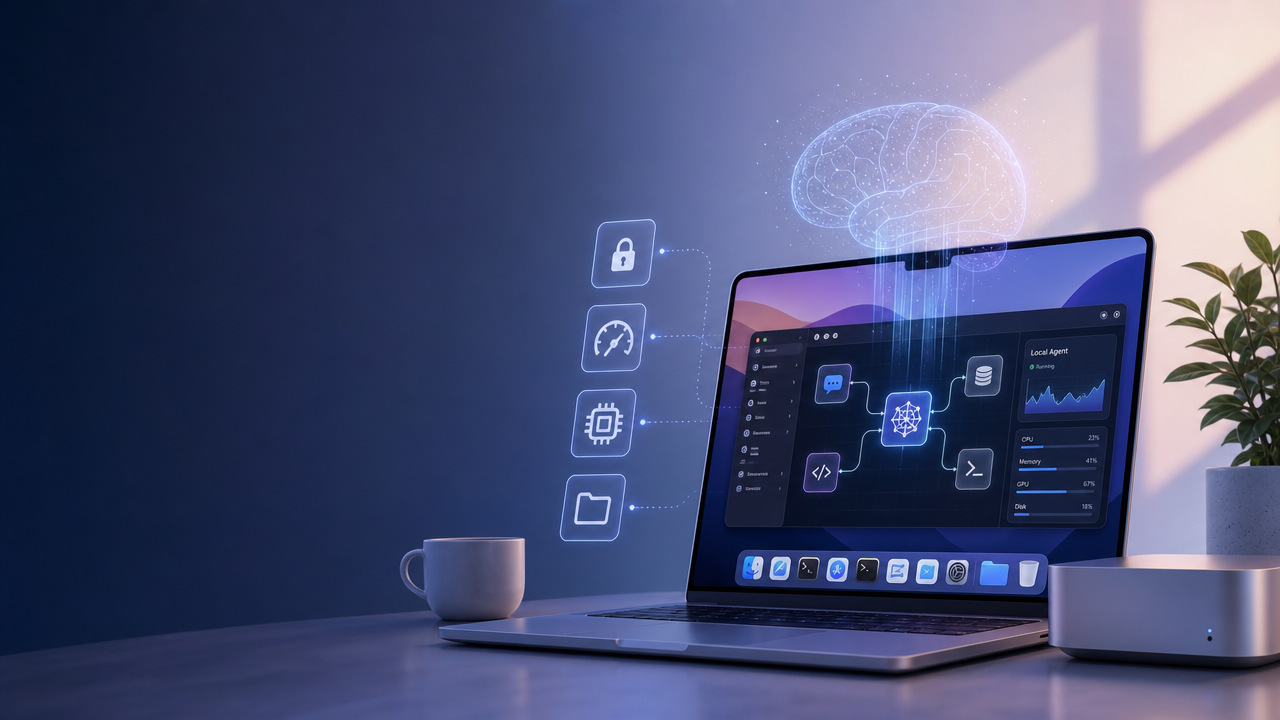
The surge in autonomous local AI agents has brought forth an intriguing debate: is Apple's macOS actually the superior runtime environment compared to traditional Linux servers or Windows desktops? With unified memory architecture and seamless integration, Mac setups are becoming a prime candidate for running local LLMs and AI workflows. But does it solve the core operational friction?
Here, we explore the strengths and weaknesses of macOS for local agents and introduce how ClawLite bridges the practical gap, transforming a powerful hardware base into a fully operational workflow solution.
Summary Q&As
Q: Can a Mac handle heavy local LLM execution? A: Yes. Apple Silicon's Unified Memory Architecture (UMA) allows the GPU to access system RAM directly, meaning a Mac with 64GB or 128GB of RAM can load massive LLMs locally—a capability that would require multiple expensive, dedicated GPUs on Linux or Windows.
Q: Is macOS fully compatible with open-source AI agent frameworks? A: Largely, yes. With the maturation of Apple's Metal Performance Shaders (MPS), popular frameworks like PyTorch natively support hardware acceleration on Mac. However, some deep learning libraries remain primarily optimized for NVIDIA's CUDA, which can introduce minor compatibility hurdles.
Q: Why use ClawLite over raw macOS setups? A: While macOS provides the raw hardware capability, deploying and orchestrating local agents often involves complex dependency management and background daemon configuration. ClawLite abstracts this layer, providing a commercially viable, out-of-the-box product layer that turns raw scripts into robust operational workflows.
Definitions
Local AI Agent: An autonomous system running on local hardware that observes its environment, makes decisions, and performs actions without relying heavily on centralized cloud APIs. Metal Performance Shaders (MPS): Apple's framework designed to accelerate complex compute tasks (like machine learning operations) using the Mac's GPU. ClawLite: A specialized product layer and workflow solution that simplifies agent deployment, process orchestration, and commercial integration, removing the friction from raw AI deployments. Unified Memory Architecture (UMA): A hardware design (notably in Apple Silicon) where the CPU and GPU share the same memory pool, eliminating the need to copy data between them.
Comparing Runtime Environments
Understanding where macOS sits in the ecosystem requires a direct comparison with its peers.
| Feature / Environment | macOS (Apple Silicon) | Linux (NVIDIA) | Windows (WSL2 / Native) |
|---|---|---|---|
| LLM Memory Cost | Low (Uses shared system RAM) | High (Requires dedicated VRAM) | High (Requires dedicated VRAM) |
| Framework Compatibility | Good (MPS support growing) | Excellent (CUDA Native) | Moderate (CUDA via WSL2) |
| Operational Friction | Moderate | High (CLI-heavy, Drivers) | High (WSL bridging issues) |
| ClawLite Synergy | High (Seamless UX integration) | High (Server-side orchestration) | High (Standardized env) |
The Friction of Raw Deployments
Despite its impressive hardware, running an AI agent directly from the macOS terminal can quickly become a tangled web of operations. You are often forced to juggle `homebrew` dependencies, virtual environments, and system processes.
When your agent needs to run 24/7, react to system events, or interface with local APIs, raw deployment starts failing. Backgrounding a Python script isn't a robust long-term solution, and writing custom `.plist` files for `launchd` is tedious and error-prone. This is exactly where the hardware potential is lost in the operational noise.
Enter ClawLite: Bridging the Gap
This is why ClawLite is essential. ClawLite isn't just another script; it is the practical product layer that connects the raw power of your Mac to an organized workflow solution.
Instead of fighting environment variables and background daemons, ClawLite handles the operational orchestration. It provides a standardized framework where your local AI agents are reliably deployed, monitored, and scaled.
Consider the difference in initiating a persistent agent workflow:
Raw macOS Terminal Approach (Fragile): ```bash nohup python3 -m my_local_agent --config settings.yaml > agent.log 2>&1 & ```
The ClawLite Approach (Robust): ```bash clawlite agent start --name "local-researcher" --env mac-mps ```
By using ClawLite on macOS, you get the best of both worlds: the massive shared memory and efficiency of Apple Silicon, combined with a commercial-grade operational advantage. ClawLite turns an experimental local setup into a dependable, production-ready system.
Conclusion
macOS is an undeniably powerful runtime environment for local AI agents, particularly for those looking to leverage large models without building expensive multi-GPU servers. However, raw hardware power is only half the equation. By integrating ClawLite, you overlay a crucial product layer that standardizes your workflow and eliminates deployment friction. Together, macOS and ClawLite form an elite, highly capable combination for autonomous local operations.