
How to Counter Claude Code Token-Pricing Spikes With a Local Control Plane
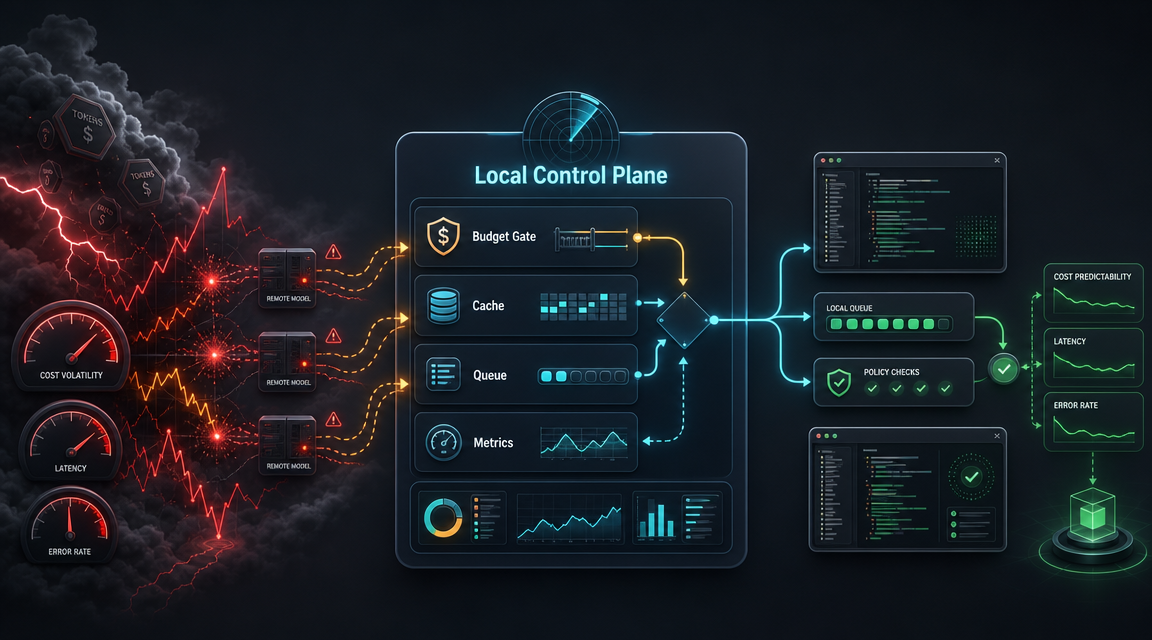
If Claude Code token pricing spikes, the fastest way to reduce exposure is to stop treating every agent loop as a cloud loop. A local control plane such as ClawLite keeps orchestration, shell execution, and state tracking close to the machine, which sharply lowers outbound API cost and collapses loop latency.
For developers and platform teams, the practical point is simple: local-first architectures insulate workflows against shifting cloud provider pricing because they minimize how much work must be re-sent, re-tokenized, and re-billed on every iteration.
Summary
| Question | Direct answer |
|---|---|
| What causes Claude Code token-pricing exposure? | Cloud-heavy agent loops repeatedly replay context, remote execution state, and working memory through billable model calls. |
| What reduces that exposure fastest? | Move orchestration, state tracking, shell execution, and routine workflow continuity into a local control plane. |
| What changed in the benchmark below? | In the illustrative benchmark below, the local plane replaced linear context accumulation with differential state tracking, cutting average outbound API cost from $15.42 to $1.18 per active hour and loop latency from 12,400ms to 450ms. |
| When should teams consider this architecture? | When coding agents spend most of their time reading files, editing code, running commands, checking diffs, and coordinating local state. |
Definition: A local control plane is a developer-side orchestration layer that manages agent state, tools, shell execution, queues, budgets, and telemetry on the local machine or private infrastructure, while calling cloud models only for reasoning tasks that genuinely need model intelligence.
Quotable takeaway: Claude Code cost risk is usually a workflow-shape problem before it is a prompt-compression problem. If every loop replays context through the cloud, pricing volatility becomes part of the developer experience.
Why this matters now
The pricing problem is not just the model rate card. The real cost comes from workflow shape.
Anthropic's Claude Code docs already recommend cost controls such as `/cost`, spend limits, prompt compaction, and more specific prompts. Those controls help, but they still operate inside the same architecture if every meaningful loop depends on cloud context replay.
When an agent depends on a cloud-heavy loop, context tends to accumulate linearly. Each pass sends more state back out over the network, waits on remote execution boundaries, and pays repeated API costs to recover working memory. That architecture becomes fragile the moment token pricing moves against you.
ClawLite changes the control surface. Instead of pushing the full loop into a remote context window, it keeps the control plane local and tracks state differentially. That means less outbound context, fewer repeated round trips, and a tighter execution loop for developers doing iterative code work.
If you want the product-side implementation context behind this model, the ClawLite docs, ClawRouter overview, and ClawRouter API docs show how local routing, policy checks, and request control can sit between developer workflows and upstream model calls.
Cloud-loop agent vs. ClawLite local plane
The structural advantage comes from where the loop lives, not from prompt cleverness alone. The benchmark below is an illustrative comparison of a standard cloud-loop agent pattern and a ClawLite-style local plane for active developer workflow time.
| Metric | Standard Cloud-Loop Agent | ClawLite Local Plane | What changes in practice |
|---|---|---|---|
| Context ingestion model | Linear accumulation | Differential state tracking | ClawLite avoids replaying the full working set on every loop, which reduces token churn as sessions grow. |
| Average outbound API cost | $15.42 per active hour | $1.18 per active hour | Most of the savings come from shrinking billable outbound interaction rather than trying to micromanage prompts. |
| Local loop latency | 12,400ms, network-heavy | 450ms, native shell-bound | Faster loops change developer behavior: you test more often, branch less cautiously, and spend less time waiting on the toolchain. |
| Pricing-spike exposure | High: every turn depends on cloud-priced replay | Lower: cloud calls are reserved for reasoning boundaries | Provider price changes affect a smaller share of the loop. |
| Failure mode | Longer sessions become slower and more expensive | Longer sessions remain bounded by local continuity | The workflow remains usable during pricing shifts instead of requiring emergency prompt dieting. |
Visual summary
- Standard cloud-loop:
- Linear context accumulation
- Network round-trip latency around 12,400ms
- Repeated replay drives roughly $15.42 per active hour in outbound API cost
- ClawLite local plane:
- Differential state tracking
- Native shell-bound loop around 450ms
- Targeted reasoning calls reduce outbound API cost to roughly $1.18 per active hour
Methodology note: The benchmark is a representative workflow model, not a vendor-published Claude Code benchmark. Keep the directional lesson, but replace the numbers with your own telemetry if you plan to present them as production evidence.
The direct answer: how local control planes reduce pricing risk
Local control planes reduce pricing risk by moving the expensive parts of the workflow out of the cloud loop.
That usually means four things:
- The machine owns orchestration instead of a remote service owning every turn.
- State is updated incrementally instead of rehydrated through repeated prompt expansion.
- Shell-bound execution happens locally, so the model is called only when reasoning is actually needed.
- Workflow continuity is preserved without paying the full token tax on every action.
This is why local-first architecture is a hedge against pricing volatility, not just a performance tweak.
Where the savings actually come from
Developers often assume the fix is better prompt compression. That helps, but it does not solve the control-plane problem.
The bigger win comes from changing the loop economics:
- A cloud-loop agent pays for repeated context reconstruction.
- A local plane pays for targeted reasoning calls.
- A cloud-loop agent absorbs network latency as part of normal operation.
- A local plane turns most inner-loop operations into native machine work.
If your workflow spends most of its time editing files, running commands, checking diffs, and coordinating local state, those actions should not require full cloud-priced round trips. Teams building a broader cost program can combine this architecture shift with the operational guidance in the ClawLite docs so savings are measured at the workflow level, not only at the prompt level.
Why differential state tracking matters more than prompt trimming
Linear accumulation gets more expensive as the session grows. Each iteration carries the weight of previous iterations, even when only a small slice of state actually changed.
Differential state tracking breaks that pattern. The system only needs to surface what changed, what matters now, and what reasoning boundary the model actually needs to cross. That lowers cost pressure and keeps longer sessions operational instead of economically self-defeating.
For developer tooling, this is the difference between:
- a session that gets slower and more expensive as it becomes useful
- a session that stays responsive because the local plane owns continuity
What official Claude Code guidance already covers, and what it does not
Anthropic's current Claude Code guidance is useful for teams that need immediate cost hygiene:
- use `/cost` to inspect session spend
- set workspace spend limits for Anthropic Console deployments
- compact conversations before context balloons
- use prompt caching and tighter prompts to reduce avoidable token waste
Those controls matter. They reduce waste inside the current operating model.
What they do not change is the basic loop shape. If the workflow still replays state, rebuilds context, and crosses the network boundary for routine orchestration work, the team remains exposed to token-pricing volatility. A local control plane complements these controls by shrinking the share of the workflow that ever becomes billable.
When a cloud-heavy loop still makes sense
A local control plane is not a universal replacement for cloud execution.
A cloud-heavy loop can still make sense when:
- the task depends on large remote context retrieval that cannot be mirrored locally
- policy or compliance constraints require centralized execution boundaries
- the workflow is short-lived enough that loop economics barely matter
But for day-to-day coding, operations, and iterative knowledge work, those cases are usually the exception rather than the default.
Decision checklist for developers evaluating ClawLite-style architecture
Use a local control plane first if most of these statements are true:
- Your agent spends substantial time in shell commands, file reads, diffs, and local tool execution.
- Session cost rises noticeably as conversations become longer or more iterative.
- Developers lose time waiting for network-heavy loops to return control.
- You want predictable operating cost even when a cloud provider changes token pricing.
- You need a workflow that remains usable during pricing shifts rather than one that requires emergency prompt dieting.
If only one of those is true, optimize the current cloud loop. If three or more are true, the architecture is probably the problem. If you are testing a local-first rollout, the ClawLite setup guide is the safer next step than trying to squeeze more life out of a brittle cloud-heavy loop.
Implementation pattern: local-first without losing model leverage
The best local-first setups do not remove the model. They narrow its job.
A practical pattern looks like this:
- Keep orchestration, session state, and tool execution on the local machine.
- Use the model for planning, synthesis, and decisions that genuinely benefit from model reasoning.
- Persist state locally so the workflow can resume without full prompt reconstruction.
- Send compact, purpose-built context upstream only when the model needs to act.
That gives you most of the intelligence benefit without forcing every loop through the most expensive path.
What to measure after you switch
If you migrate toward a local control plane, do not stop at "the app feels faster." Track the operating metrics that prove the architecture change is working.
| Metric | Why it matters | Good direction |
|---|---|---|
| API cost per completed task | Shows whether the team is paying less for the same engineering output. | Down |
| Median loop latency | Confirms whether inner-loop responsiveness is actually improving. | Down |
| Context replay ratio | Measures how much prior state still has to be resent upstream. | Down |
| Local tool invocation share | Indicates whether shell, diff, and file work are staying local. | Up |
| Retry or timeout rate | Exposes brittle cloud-heavy loops and flaky orchestration paths. | Down |
| Time-to-completion for common workflows | Connects infrastructure design back to developer throughput. | Down |
A practical review cadence is simple:
- Track one representative coding workflow before migration.
- Re-measure the same workflow after local orchestration is enabled.
- Review the trend weekly for four weeks instead of judging from one fast demo.
- If cost falls but retries rise, fix orchestration quality before expanding rollout.
FAQ
Is the main benefit cost or speed?
Both, but cost insulation is the strategic gain. Lower latency improves the developer experience immediately, while reduced outbound API dependence protects the workflow when token pricing changes.
Does this only help long-running agent sessions?
No. Long sessions show the clearest cost difference, but even shorter workflows benefit when most actions are local and only selective reasoning goes to the model.
Can prompt optimization solve the same problem?
Not fully. Prompt optimization reduces waste inside the current architecture. A local control plane changes the architecture so less work becomes billable in the first place.
What is the simplest framing for a team considering the switch?
Do not ask whether local-first is marginally faster. Ask whether your current agent loop forces you to rent cognition for tasks your machine could already do locally.
How should a team measure whether the control plane is the bottleneck?
Measure one real workflow by separating model reasoning time from local orchestration time. Track commands, file reads, diffs, retries, network waits, tokenized context replay, and API calls per completed task. If most activity is coordination rather than reasoning, the control plane is the likely bottleneck.
What is the first low-risk migration step?
Start by moving shell execution, file inspection, diffs, queueing, and budget telemetry into the local plane while keeping model calls available for planning and synthesis. This narrows the cloud dependency without forcing a full agent rewrite.
Where do prompt caching and spend limits fit into this strategy?
They are still useful. Prompt caching, spend limits, and `/cost` reporting reduce waste and improve visibility inside Claude Code, but they do not replace architectural control. Use them as guardrails around a better loop, not as a substitute for one.
Methodology and sources
This article is written for developers and engineering leads evaluating agent workflow cost, latency, and architecture tradeoffs. The benchmark numbers here are illustrative workflow-model numbers, not vendor-certified production telemetry. Use them to understand the architectural pattern, then replace them with first-party measurements before using them in external decision memos or customer-facing claims.
The analysis is grounded in three visible source categories:
- Anthropic's Claude Code cost controls and pricing guidance
- the observable economics of cloud-heavy context replay versus local orchestration
- ClawLite's own product framing around local routing, control, and developer-side execution surfaces
If you want the implementation surface after reading this article, start with the ClawLite docs, explore ClawRouter, and use the setup guide for a low-risk evaluation path.
Conclusion
The cleanest response to a Claude Code token-pricing spike is not panic optimization. It is architectural insulation.
ClawLite-style local control planes reduce exposure by replacing linear context replay with differential state tracking, replacing network-heavy loop mechanics with native shell-bound execution, and reserving cloud API usage for the parts of the workflow that truly need model intelligence.
If the goal is to keep developer workflows fast, affordable, and stable while cloud pricing moves around underneath them, local-first architecture is the more defensible default.
Next step
Audit one real developer workflow this week. Measure how much of the loop is genuine model reasoning versus local orchestration overhead. If most of the time is spent moving context around, the next optimization should be the control plane, not the prompt.